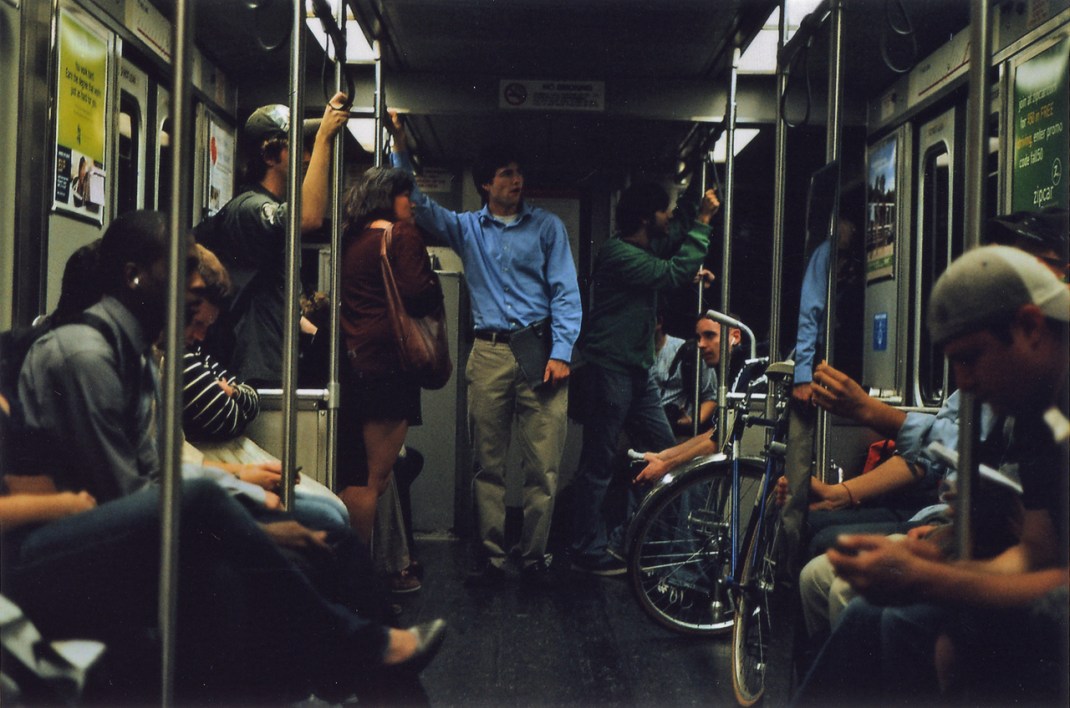
We all know this moment: You see an attractive figure out on the street, across the room at a restaurant or next to you in public transport. You position yourself so you can follow their movement. You find an excuse to get closer. You take a glance at the face and it’s gorgeous. Your muscles tense and adrenalin goes rushing through your blood. What might this person be like? Has s/he noticed you as well? Is there any way you could start a conversation? The idea of actually walking over and saying hello scares the shit out of you. You’re nervous and your breath is gone. So the answer to that last question is usually a resounding nope.
In defense of offline dating
Approaching strangers in the real world and revealing one’s interest feels so uncomfortable and risky that most people never dare to follow that impulse. In this essay I want to explain why it makes a lot of sense to overcome this mental barrier. I will dismantle the main arguments commonly brought forward against the idea of proactively meeting new people offline. And I will show why being able to do this is in fact a true super-power in today’s dating landscape.
A. It’s inefficient
Let us begin by addressing one of the most common objections against offline dating: “It’s inefficient!” The reasoning usually goes as follows: When you meet someone randomly on the street you don’t have a whole lot of information about them so you cannot filter according to your preferences. You could be looking at a convicted sex offender, someone who is happily married with kids or someone who just doesn’t have anything in common with you. There are usually not enough time and interaction opportunities in the shared public space to build trust and find out if you would make for a compatible match. So trying is a waste of time.
I do not agree with this argument for 3 reasons:
First, the way someone looks and behaves on the outside actually says a lot about the person. When you feel drawn to a stranger it means that you saw something on their surface or in their behavior that resonated with you and evoked your curiosity. Purely physical beauty certainly plays a role but usually there is more: The way someone dresses, the accessoires they wear, the things they do and the way they carry themselves. These are all choices of the person, a form of expression, and thereby linked to their true identity. Given the huge diversity in humans and the evolutionarily evolved intelligence of the human attraction apparatus, the fact that you liked something on the outside is already a good indicator that you might have more in common on deeper levels, too. In fact, complimenting something you noticed on the other person is one of the best ways to start a conversation and often helps build an immediate and genuine connection.
Second, once you have started a conversation, it’s actually very easy to find out if your initial interest was justified and whether it is in any way reciprocated from the other side. Human brains are extremely good at finding connections. You will find out within a minute of talking whether you have shared interests and could potentially get along. If the other person is not open to meeting new people, you will be rejected and blown out immediately. If there is no connection, the conversation will quickly fall apart. In both cases you will not have lost much time so the cost of trying is negligible.
Third, even if it turns out that you are not romantically interested in each other, talking to strangers is often still the best use of your time. Meeting the love of one’s life is great but even just a casual chat is better than what we usually do in those uninspiring public spaces: instagram, candy crush or blankly staring at the floor. When you approach someone and it turns out there is no chance for a romance, you can still have an enjoyable conversation and learn something interesting, network for business or just be friends. In today’s Western civilization, a stranger starting a conversation is no longer a safety concern but rather a valuable source of inspiration, knowledge and entertainment. Apart from the immediate benefits, this will also strengthen your social skills and make you more apt at navigating future interactions where more is at stake.
Another way to evaluate the efficiency of offline dating is to compare it against its main alternative: online dating. Online dating can save you a lot of time and energy because it only shows you people who are available and somewhat interested so you don’t have to sieve through masses of ‘incompatibles’. However, not everyone gets to experience these benefits: Especially on the male side, a large proportion of users complain that they simply don’t get any attractive matches online. Indeed it turns out that the distribution of likes from women is extremely uneven. Women are more picky than men. They only like the most attractive seeming men and this judgement is based mainly on photos.1 If you don’t perform well in this race, maybe because looks are not your strong suit or maybe because you are part of a racial minority that suffers from discrimination on the dating market, your chances of success are slim. An obscure algorithm will give you a low ranking and put you into the league it thinks you belong in. You stand a better chance to get matches offline because the real world is a better place to display your full personality and character strengths. None of the girlfriends I ever had would have swiped me right based on pictures alone.
There is one more important reason why offline trumps online when it comes to efficiency: You get a much better feel for the other person by sharing a real-world moment than by just looking at their staged online appearance. Most people present a highly stylized version of themselves on dating apps and many a picture is photoshopped beyond recognition. This means that online daters often find themselves in the most awkward and wasteful of situations: A date where there is no chemistry at all because someone completely misestimated the attractiveness of the other. This is almost impossible with offline dating. After spending a few minutes with a person you can be quite sure about whether you feel physically attracted and make a much more sound decision on whether you want to continue the interaction.
B. It’s uncomfortable
A more valid critique of offline dating is that it is uncomfortable. When you approach someone and express your interest you make yourself vulnerable because you run the risk of being rejected. Few things in life are more psychologically scarring than getting rejected on the sexual marketplace – especially in the real world and especially in public. So if you want to save yourself a lot of pain and misery don’t approach strangers in the streets. In fact, this is the raison d’etre of online dating: It hides all the moments of rejection – you don’t get notified when someone swipes left on you. It only presents you with the (ever so rare) moments of approval.
There is nothing wrong with this argument, except that it misses one important thing: The fear of rejection – despite having deep evolutionary roots – is not a universal constant that exerts the same force on all humans at all times. It can be significantly reduced with practice and rational thought. And thus you can actually turn offline dating into something enjoyable and rewarding!
Almost everyone who went down this path will tell you a similar story: The first few hundred approaches are usually utter failures. You stumble and mumble and creep out all living creatures within a hundred meter radius. You get rejected and publicly humiliated. Then you realize that this is actually the worst thing that could have happened. You look at yourself and find that your body and mind easily survived the attack. The pain fades away. With a little bit of reflection you even feel funny about those interactions. In the second and third month you already experience far less anxiety and your conversations become more smooth and enjoyable for both sides. Even if you don’t end up going on lots of dates, yet, you build massive confidence and social skills. You learn to accept rejection without letting it pull you down, you get better at presenting yourself and you figure out how to navigate complex social situations. All of this does not just improve your dating prospects, but also makes you grow as a person in the other areas of your life. You start seeing the process as a heroic transformation. And the discomfort as a necessary part of it. Online dating rarely triggers a personal development journey like this.
C. It’s inappropriate
A third line of attack against offline dating is that hitting on strangers is inappropriate. This argument comes in several variations:
Some find it disrespectful to approach someone in the real world because it is a form of unsolicited attention and an invasion of their space. In today’s mainstream hetero society it is usually the man who goes out of his way to actively approach a woman. Given the long history of male sexual violence women can easily feel unsafe in such a situation. Even just having to say no and reject an unknown man can trigger anxiety, especially in a low-trust environment that does not regularly support social interaction between strangers.
I recognize this danger but in my own experience have found it rather easy to circumvent. When you approach with good intentions and make it clear that you will not bother someone if they are not interested, people rarely feel threatened. Once you have learned how to start interactions they are actually happy to receive real-world attention rather than being annoyed at getting too much. Most of the women I talk to about this even complain that they don’t get approached as much as they would like to by men! They feel disrespected and uncomfortable not when a man approaches them and makes a compliment or starts a conversation, but rather when that conversation turns weird and the man doesn’t take no for an answer. What also creeps women out is when the man doesn’t approach and instead just lurks around or drunkenly catcalls with his friends. So while there are certainly ways to do offline dating that are disrespectful, there is nothing disrespectful about offline dating in and of itself. It is your responsibility to learn how to do it the right way and to get to a point where your approach makes the other person’s day even if she is not interested in you. Aim to make every interaction a win-win.
Another reason why offline dating is often deemed inappropriate is that it allegedly objectifies humans. As described above, when you feel drawn to a stranger in the real world the attraction is initially based on a superficial quality, most often physical beauty – after all, you don’t know anything else about that person. Thus, in that moment you tend to reduce the person’s value to the sexual attraction you feel for their bodily presence and this can be seen as dehumanizing.
I never quite understood this line of critique, mainly because the meaning and morality of “objectifying humans“ mystify me. We all constantly reduce people to a certain value we see in them. We cannot always process the world in its full complexity so this is an absolutely necessary abstraction: The world of business and advertisement provides a useful analogy: A company identifies its target audience based on demographics, preferences, past buying behavior etc. and then tries to convert them into paying clients valued in terms of the cashflow they provide. Similarly in dating we look for indicators of mate value – with physical attraction being one important component and often the first filter (equally or more so in online as in offline dating) – and try to attract the most valuable partners for more intimate relationships. We can all agree that there is nothing inappropriate about this.
The problem with objectification only occurs when you don’t go beyond the initial abstraction level even as you gather more information about a subject and deepen the relationship. In business this would be trying to push people who are in the target group into buying the product even after learning that they are actually not interested. Not everyone who is in the target group will actually want the product but if a company only cares about cashflow it can still use psychological manipulation to trick them into buying.
Similarly, in dating, being physically attractive is only a necessary condition, not a sufficient condition, for being a potential mate. When you start a conversation with a super attractive person and find out that your personalities are incompatible, there is a temptation to apply pickup maneuvers to get the person to like you and into bed just because they were physically attractive. But of course the better idea is to take the information about their character into account, adjust your value abstraction and back off.
Again, the objectification critique of offline dating is actually directed not at offline dating per se but rather at a human tendency that plays itself out in all dating strategies, business and life at large. In fact, inappropriate objectification is much more common in the world of advertisement and online dating where superficial factors are often overemphasized and blown out of proportion. By approaching a stranger and actually talking to them you do the most un-objectifying thing possible: You interact with them and are forced to see them as a human with language, thought, decisions and agency of their own. You quickly look beyond the surface and give the other person a chance to be more than an abstract object in your life. Objectification is everywhere but that said, offline dating done right is one the least objectifying activities one can engage in.
Don’t hate the game, hate the player
I hope this essay convinced you of the many benefits of meeting romantic partners in the real world rather than looking online. Counterintuitively, offline dating is actually more efficient for most people at procuring high-quality matches. It contributes directly to one’s general personal growth. And it is in fact less objectifying and dehumanizing than dating apps.
There are certainly ways of doing offline dating with questionable intentions and methods. However, these behaviors are based on general human tendencies that are equally if not more heavily represented in other forms of partner search. Nevertheless, I want to distance myself very explicitly from these unethical tendencies (in fact this is one of the reasons for the ‘No’ in NoGame). In line with the ideas outlined in this essay I also released a new version of the NoGame app: Apart from improved UX, it dispenses with classic pickup vocabulary and replaces it with more inclusive, humane and consensual wording. It is not enough for NoGame to motivate people to go out and approach more strangers in the real world. NoGame must also support and educate users to do it the right way.
Footnotes
- Data from the dating app hinge shows that the Gini coefficient (a measure for unequal distribution) for likes is 0.38 for women and 0.54 for men.
 Achill Rudolph